
In the latest draft of the Code on Social Security Bill, 2019, the government has decided to stick to the current thresholds for providing social security benefits to workers by industry.

The government is set to ask PSBs to expeditiously introduce repo-rate linked products "to step up affordable credit".

Mastercard recently launched an authentication product called Identity Check Express that enables customers to verify transactions on their own.

The plan includes step-wise expansion of a crucial credit guarantee net, establishment of an unprecedented number of functional clusters and increased government procurement from MSMEs.

The government wants to reduce the rate of contribution - part of the employee's share - for a class of workers depending upon age, income or gender, without changing the contribution from the employer's share.

Under the proposed mechanism, the finance ministry has said banks will notify customers when someone tries to deposit money in their accounts, a government official said.

Three years and Rs 28,710 crore worth of transactions later, it has more than double the number of sellers than Flipkart.

The Bill states a worker will be paid twice his or her wage if he or she is allowed to work overtime. A majority of workers in India worked more than 48 hours in a week, which is higher than the International Labour Organisation's prescribed time-limit.

Garg had refused to sign on the report finalised by the former Reserve Bank of India governor Bimal Jalan-led committee reviewing the central bank's economic capital framework (ECF).
Single registration will be coupled with single licence, along with a single return, for executing projects for five years.

Under the New Code on Wages Bill 2019, employers will be required to give the minimum wages, notified by either the state or the Centre, to the unorganised sector, too.
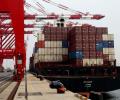
According to data released by the commerce and industry ministry, exports stood at $25.01 billion in the month. The fall is only the second time exports contracted in the past year.

Government suspects that many of these bank accounts were used to launder money, especially after the demonetisation in November 2016.

The aim of the programme is to increase the water table in the stressed areas through dams, ponds, and afforestation. According to a NITI Aayog study, by 2030, the country's water demand is projected to be twice the available supply, implying severe water scarcity for hundreds of millions of people and an eventual 6 per cent loss in the country's GDP.

After assuming power in 2014 with a full majority of its own, the BJP-led NDA government started an ambitious process of reforming labour laws in the form of codes aimed at making the framework less cumbersome with a variety of alterations. It had planned four codes each for industrial relations, wages, social security and welfare, and occupational safety, health and working conditions. To this end, 35 central labour laws were to be converted into four codes that would have had the virtue of streamlining labour relations. But none of the proposed code Bills could be converted into a law principally because neither trade unions nor industry representatives came on board. They hold the key to India's low-growth-high unemployment paradigm but the government may struggle to push them through this time as well. Somesh Jha explains why

Emirates and Etihad Airways have over the past year continued to lobby India to allow them more flight slots, which won't be possible until the 2007 pact is revised.
'If there is a technical issue and the borrowers can resolve it within 30 days, you don't have to go through the bankruptcy court.' 'If the borrower is expecting a large disbursal of a facility or expecting a payment or receivables, in such cases it becomes practical to give a window for taking care of such circumstances. 'If banks had aggregated the assets and benefited with a long relationship with borrowers and now when assets get into a trouble, it is incumbent on banks to find resolution and take responsibility.'

However, in recent times, the clout that trader bodies such as CAIT and other organisations like Swadeshi Jagran Manch and Laghu Udyog Bharati has is steadily increasing. Earlier this year, trader bodies were able to convince the government not to extend the deadline for implementation of the new norms in FDI policy on e-commerce.

The commerce department has said that earnings through the new tax will equal the losses faced by Indian industry after the US tariffs on steel and aluminium.

While the UN report said that FDI inflows rose 6 per cent in 2018 to $ 42 billion, the government's own data for the entire FY19 period has shown that inbound equity investments declined for the first time in six years in FY19.
 © 2025 Rediff.com - Investor Information - Advertise with us - Disclaimer - Privacy Policy - Sitemap - Feedback - About us - Terms of use - Grievances